

CES 2026 will be held at the Las Vegas Convention Center from January 6 to 9 (local time), with approximately 4,500 companies from around 150 countries participating in this year's event. The Consumer Technology Association (CTA), which organizes CES, evaluates entries annually to select the Best of Innovation Awards and Innovation Awards. According to the CTA, over 3,600 products and services were submitted this year, with 43 products receiving the Best of Innovation Award and 416 products receiving the Innovation Award.
A total of 39 companies received the Best Innovation Award and Innovation Award in the Digital Health category, with 41 products honored. Among these, Korean companies accounted for half—21 companies and 23 products. In the Digital Health category, various products enhancing healthcare functions in daily life, such as personal health monitoring, radar-based fall detection, and water quality management, made the award list.
Non-invasive diagnostics and healthcare expansion… extending to remote monitoring, lifestyle medicine, and wellness
Atoplex won the Innovation Award for its multi-test molecular diagnostic device, the 'GenHome Array'. Previously, at CES 2024, 'GenHome' received the Innovation Award in the same category. The GenHome Array is a next-generation point-of-care testing (POCT) device that uses the same cartridges as the existing GenHome while automatically testing up to eight samples simultaneously. The entire process, from nucleic acid extraction after sample loading to result interpretation, is automated. It precisely analyzes even minute signals using AI-based CCD image analysis technology.
ExoSystems has been recognized for the innovation of its AI-based musculoskeletal exercise management solution, 'exoRehab'. This solution manages lower limb muscle health by measuring knee joint range of motion (ROM) and muscle bio-signals (EMG), providing personalized exercise programs and delivering electrical stimulation for rehabilitation.
Exopert won an innovation award for its multi-cancer early diagnosis platform based on exosomes, AI, and Raman spectroscopy (SERS). Exosomes are extracellular vesicles abundantly secreted during the early stages of multiple cancers. They contain molecular information from cancer cells, providing crucial clues for early diagnosis. Exopert combines SERS technology with AI pattern recognition algorithms to precisely analyze these exosomes. This approach achieves higher accuracy and efficiency compared to existing diagnostic methods.
Koryo Otron received an innovation award for its surface acoustic wave (SAW)-based microfluidic platform, the 'KOC CTC SAW MicroLab'. This platform separates and analyzes minute cancer cells in blood in real time. Unlike conventional bulk separation methods, surface acoustic wave (SAW) technology minimizes sample loss and preserves cell viability.
CareDream gained attention for its non-invasive senior life log integrated monitoring system 'Carearly'. This system utilizes air pressure-based cardiac sensors to measure key vital signs such as heart rate, respiration, and movement without physical contact. Moving beyond existing single-measurement methods centered on bed sensors or wearables, the sensors can be applied to various types of equipment and spaces.
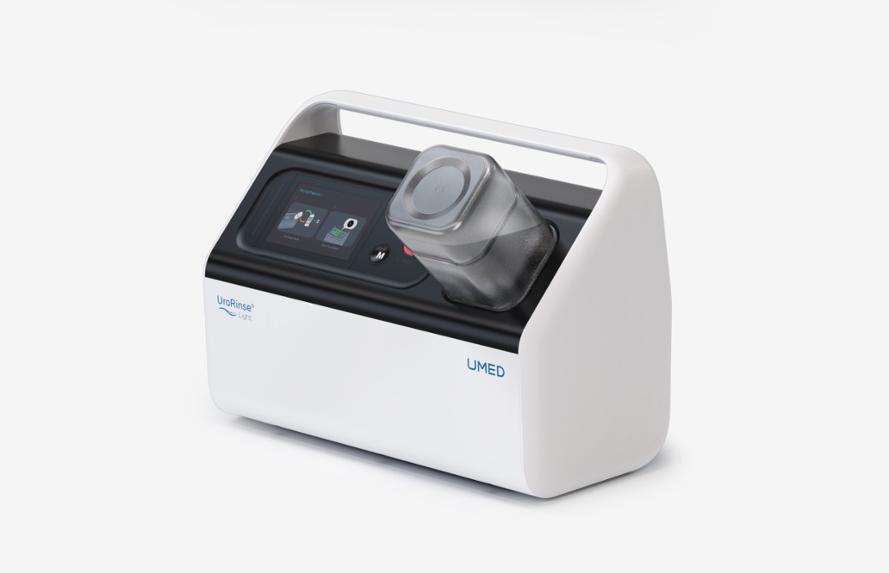
Umed introduced a solution to reduce infection risks for long-term catheter patients with its automated bladder irrigation system, 'UroRinse Light'. This world-first system automates and standardizes the bladder irrigation process for catheter users, enabling safe and consistent irrigation previously only possible in hospitals to be performed in nursing facilities and at home. Furthermore, sensor-based control technology automatically regulates the inflow and outflow of the irrigation solution to maintain consistent cleaning efficiency. Its closed-system structure minimizes the risk of external infection during the cleaning process.
UniPlatec received an innovation award for its filterless air sterilizer. It incorporates semiconductor photocatalyst technology enabling sterilization and deodorization without filter replacement, featuring a self-cleaning capability. Its sleek, ultra-thin design resembles a liquid dispenser, earning recognition as an interior-integrated air sterilization solution.
Serazem won the Innovation Award for its 'Medispa All-in-One AI' and 'Clinical One Entry System'. Medispa All-in-One AI is a portable K-beauty device that combines 3D facial scanning with lifestyle data to suggest care optimized for skin type and condition, demonstrating the future direction of personalized beauty tech. The Clinical One Entry System is an AI-based contactless health platform. It uses facial recognition to measure and analyze core vital signs—including body temperature, heart rate, respiratory rate, and oxygen saturation—to determine access permission. It also continuously monitors individuals within the facility after entry, detecting early signs of health deterioration to respond to emergency situations.
Kolmar Korea achieved a double win by receiving the Best Innovation Award in the Beauty Tech category and the Innovation Award in the Digital Health category for its beauty device 'SCAR', which combines AI-based scar diagnosis, treatment, and coverage functions. SCAR is a product utilizing AI big data and piezoelectric micro-spray technology. When the wound area is photographed via a smartphone app, the AI algorithm classifies and analyzes the wound type into 12 categories. It then precisely dispenses the appropriate treatment using piezoelectric micro-spray technology. Simultaneously, it sprays a cover-up makeup powder, combining over 180 shades tailored to the user's skin tone, enabling both wound treatment and makeup coverage in one step.
Parmiti won innovation awards in both the AI and digital health categories for its 'FIRA Pose' technology, which applies mmWave radar and AI-based 3D posture and behavior recognition. This integrated platform collects biometric and behavioral data non-contact and performs 3D recognition and analysis. Currently, PamiTi is advancing its mmWave radar-based non-contact biometric signal acquisition (heart rate, respiration, etc.), 3D behavior estimation, and AI-based post-processing algorithms. Through FIRA Pose, it has implemented these core technologies as a single integrated solution.
(omitted)